I am learning flutter from JustAcademy, They provide very much great environment where people gather and work simultaneously. totally project based training institute.
MOHD ABU BAKAR ANSARI
Flutter Developer
Awesome Experience. I am a Front-end Web Designer working at Star India for 3 years now. I applied for Full-stack development and my experience has been phenomenal & they really do help with placements exceptionally. Thank you Roshan sir so much.
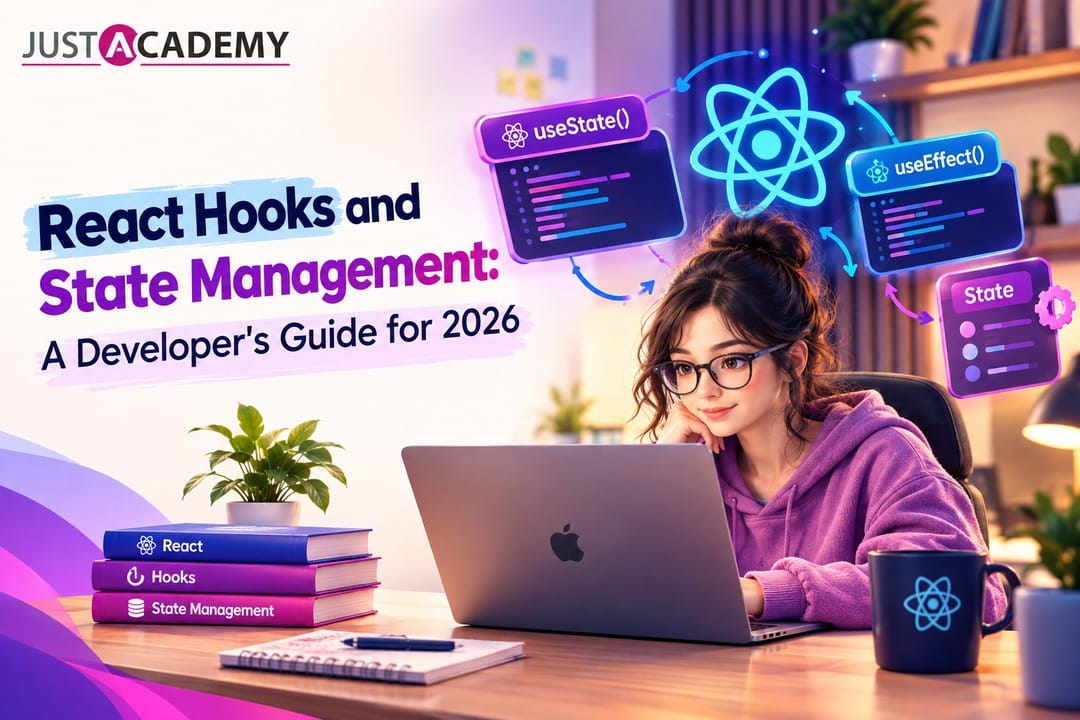
From useState to Zustand, everything a Pune based developer needs to build modern, scalable React applications
If you have spent any real time writing React over the last few years, you already know the story. Class components used to run the show, this.setState was everywhere, and lifecycle methods like componentDidMount felt like a rite of passage every new developer had to survive. Then hooks arrived, and honestly, they did not just tweak the syntax, they changed how people think about building interfaces. Today, when someone talks about state management in react, they are almost always talking in the language of hooks, whether that means a simple useState call or a full blown state management library in react like Zustand or Redux Toolkit.
This guide is written for developers in Pune who are serious about mastering react hooks and the wider ecosystem around them, from react native to next js. Since JustAcademy runs its classroom campus out of Mumbai, most learners joining us from our react js training in Pune program actually prefer the live interactive online batches, sitting with a mentor on video, asking questions in real time, and getting the same instructor led experience without needing to travel. If you would rather see this in action before reading further, you can always book a free demo and sit in on a live session yourself. We will get into that a bit later, but first, let us actually talk about the code and the concepts, because that is what you are really here for.
Why This Topic Still Confuses Even Experienced Developers
You would think that after so many years, react hooks would feel completely settled. They do not, at least not for everyone. New developers often confuse local component state with global application state. Mid level developers sometimes reach for Redux out of habit even when a project barely needs it. And plenty of react native developers still treat mobile state management as if it works identically to the web, which it mostly does, but with a few quirks worth knowing.
Why React Hooks Changed the Way We Build Interfaces
Before hooks, if you wanted state or lifecycle behavior, you needed a class. Functional components were treated as the lightweight, almost secondary option. Hooks flipped that completely. Suddenly, functional components could hold state, respond to side effects, and share logic across components without wrapping everything in higher order components or render props gymnastics.
The Shift From Class Components to Functional Components
Functional components paired with hooks made component based architecture genuinely simpler to reason about. You write a function, you call a hook or two, and the component just works. There is less boilerplate, fewer confusing bindings of this, and the code reads closer to plain javascript, which matters a lot when you are trying to onboard a junior react developer onto a live production codebase.
Hooks as the Foundation of Modern React Development
Every major pattern in react js development today, from data fetching to animation with tools like framer motion, sits on top of hooks. Even react native hooks follow the same rules, so once you understand hook react native usage, moving between web and mobile projects becomes far less intimidating. This is exactly why our react js training in Pune spends real time on hook fundamentals before jumping into frameworks or libraries.
Getting Comfortable with useState and useEffect
Almost every react hooks tutorial starts here, and for good reason. If you do not fully understand these two, everything downstream, including context, custom hooks, and third party libraries, will feel shaky.
How to Import useState From React Correctly
The pattern is simple once it clicks. You import usestate from react like this in a functional component:
That single line gives your component memory across renders. No class, no constructor, no binding methods manually. Beginners sometimes assume state updates happen instantly, but React batches updates, which is a subtle detail that trips up a lot of people during react interview questions.
useEffect and the Side Effect Problem
useEffect replaced componentDidMount, componentDidUpdate, and componentWillUnmount all in one hook. It handles anything that reaches outside the component, api calls, subscriptions, timers, or manually updating the DOM. The dependency array is where most bugs live. Get it wrong and you either run an effect too often or miss updates entirely. This is one of those areas where a mentor led session genuinely saves hours of confused debugging compared to reading documentation alone.
Beyond the Basics: useTransition, useDeferredValue and Concurrent Rendering
React did not stop evolving after the first wave of hooks. Concurrent features are quietly becoming essential knowledge for anyone doing serious frontend development in 2026.
What useTransition Actually Solves
usetransition lets you mark certain state updates as non urgent. Imagine a search box filtering thousands of items while the user is still typing. Without usetransition, typing feels laggy because React tries to update everything at once. With it, the input stays responsive while the heavier list update happens in the background.
When to Reach for useDeferredValue Instead
usedeferredvalue is closely related but slightly different. Instead of wrapping the state update itself, you defer a value, letting React use a slightly stale version while it prepares the fresh one. For a react developer working on dashboards or data heavy interfaces, knowing when to pick usetransition over usedeferredvalue, or vice versa, is becoming a fairly common react interview questions topic at product companies.
Understanding State Management in React: The Real Problem
Here is the part most tutorials rush through. State management in react is not really about which library you pick, it is about understanding what kind of state you are dealing with in the first place.
Local State vs Shared State vs Server State
Local state lives inside one component, think of a react js checkbox toggle or a form field. Shared state needs to be accessed by multiple components, like a logged in user object. Server state is data fetched from an api that needs caching, refetching, and synchronization. A lot of the pain developers feel with state management in react comes from treating all three the same way, usually by shoving everything into one giant global store.
Passing data down five or six component layers just so a deeply nested component can use it is exhausting and error prone. This exact frustration is why the Context API exists, and later, why lighter state management library in react options like Zustand and Jotai gained so much traction among developers who found Redux too heavy for smaller apps.
Context API vs Zustand vs Jotai: Picking the Right State Management Library in React
This is probably the single most searched comparison among react js developers right now, and it deserves an honest answer rather than a one size fits all recommendation.
A Closer Look at Each Option
Context API ships with React itself, so there is nothing extra to install. It works well for state that does not change too frequently, like theme settings or authentication status. Zustand takes a minimal approach, using a simple store pattern without the ceremony of actions and reducers. Jotai react takes an atomic approach, where each piece of state is its own small unit, which scales nicely for complex, interconnected UI state.
Comparison Table: Context API vs Zustand vs Jotai
Feature
Context API
Zustand
Jotai
Setup effort
Built in, no install
Very minimal
Minimal, atom based
Best for
Simple, infrequent updates
Small to mid sized apps
Complex, interconnected state
Re render control
Limited, can cause extra renders
Good, selective subscriptions
Excellent, atom level updates
Learning curve
Low
Low
Moderate
Devtools support
Basic
Good
Good
Choosing the Best State Management Library for React on Your Project
If your app is small with a handful of shared values, Context API alone is fine. If you are building something with moderate complexity and want simplicity without extra boilerplate, Zustand is usually the sweet spot. If your application has many small, independently updating pieces of state, especially in dashboards or design tools, Jotai's atomic model tends to hold up better as the codebase grows.
React Hooks vs Redux: Does Redux Still Matter in 2026
There was a period where every serious react js application reached for Redux by default. That default has faded, but Redux has not disappeared, it has just found its proper place.
Where Redux Still Wins
Large enterprise applications with complex business logic, strict data flow requirements, and large teams still benefit from Redux, especially with Redux Toolkit removing most of the old boilerplate complaints. Predictable state transitions and strong devtools support matter a lot when dozens of developers touch the same codebase.
When Hooks Alone Are Genuinely Enough
For most small to mid sized products, react hooks combined with Context API or a lightweight state management library in react like Zustand will comfortably cover your needs without pulling in Redux's additional complexity. Understanding this tradeoff, rather than picking based on trend, is exactly the kind of judgment that separates a junior developer from someone who can architect a project independently, and it is a recurring theme we walk through during our react js training sessions for learners joining from Pune and other cities.
React Native Hooks and Cross Platform State Handling
A growing number of learners want to build mobile apps, not just websites, and react native hooks make that transition smoother than people expect.
How React Native Hooks Differ From Web Hooks
The good news is that react native hooks follow the exact same rules as react js hooks. useState, useEffect, and custom hooks behave identically. The differences show up in the surrounding APIs, like handling a react native text field, managing keyboard behavior, or dealing with platform specific storage instead of browser based storage.
Managing State Across Screens in React Native Software
Navigation adds a layer of complexity that web development does not usually deal with. State needs to survive screen transitions, background app states, and sometimes offline periods. This is where a proper state management library in react native, whether that is Zustand, Redux, or Context, becomes less of a preference and more of a necessity, especially for react native mobile development projects with several screens sharing data.
Building Real Components: From Checkboxes to Text Fields
Concepts matter, but so does the everyday reality of building components that actually work in production.
Handling Simple Inputs Like a React JS Checkbox
A react js checkbox seems trivial until you need to manage a group of them, sync their state with a form library, and validate selections before submission. Hooks make this manageable because the checked state, the change handler, and any derived validation logic can live cleanly inside the component or a custom hook.
Bringing Interfaces to Life With Framer Motion
Once the functional logic is solid, developers often turn to framer motion to add smooth transitions and micro interactions. Framer motion works naturally alongside hooks, since animations frequently respond to state changes, like a modal opening when a boolean flips from false to true.
Component Based Architecture as a Long Term Habit
Whether you are building with react js, react native, or exploring next js for server rendered applications, thinking in terms of component based architecture keeps your codebase maintainable. Small, focused, reusable components paired with well organized hooks age far better than large, tangled components trying to do everything at once.
React Hooks in Interviews: What Companies Are Actually Asking
If you are preparing for a role, whether as a fresh react junior developer or someone negotiating a react developer hourly rate as a freelancer, interview preparation deserves its own focus.
Common React Interview Questions Around Hooks
Expect questions comparing useState against useReducer, explanations of the dependency array in useEffect, scenarios comparing react hooks vs redux, and practical comparisons like context api vs zustand for a given use case. Interviewers increasingly also ask about usetransition and usedeferredvalue, since concurrent rendering questions have become common at companies working on performance sensitive products.
Why a React Hooks Cheat Sheet Is Not Enough
A react hooks cheat sheet is genuinely useful for quick revision, but interviewers usually push past memorized definitions and ask you to reason through a scenario live. This is where practicing with a mentor, explaining your thought process out loud, and getting immediate feedback makes a measurable difference compared to solo preparation. If you want a deeper look at how certification can support this kind of preparation, our detailed breakdown on react js certification covers what recruiters actually look for on a resume.
Why Structured, Instructor Led Training Beats Solo Learning
Reading documentation and watching scattered videos can only take a developer so far. At some point, the gaps in understanding start showing up in interviews, in code reviews, and in production bugs that a mentor could have flagged in five minutes.
The Value of Live Interactive Sessions for Pune Based Learners
JustAcademy operates its physical, offline classroom out of Mumbai, and increasingly out of a growing Pune community of learners who prefer joining through live interactive sessions instead of commuting. These are not pre recorded courses. They are genuine instructor led, mentor led classes conducted in real time, where a Pune based developer can ask a question about useEffect dependencies or a state management library in react and get an answer immediately, exactly as they would in a physical classroom.
For anyone in Pune specifically looking to build strong fundamentals, our react js training in Pune program is structured around this same live, mentor guided format, covering hooks, state management, and real project work rather than isolated theory.
Placement Support and Practical Project Exposure
Beyond the technical syllabus, structured training brings placement support, resume guidance, and mock interviews that solo learners rarely get access to on their own. Working alongside a mentor on real projects, rather than isolated tutorial exercises, tends to build the kind of confidence that shows up naturally during technical interviews.
Learners who want to go beyond just react and pick up the surrounding javascript ecosystem, including modern es6 plus features that hooks rely on internally, often pair this with our javascript training in Pune, since a strong javascript foundation makes hooks, closures, and state updates far easier to internalize.
If your goal is a complete, job ready skill set rather than isolated topics, our full stack developer pro bootcamp in Pune combines frontend, backend, and deployment knowledge into one guided track with live mentorship throughout.
And for developers who specifically want to build modern, product ready applications using react on the frontend with node js and mongodb on the backend, our MERN stack developer bootcamp in Pune walks through exactly this stack with real, startup style project builds rather than isolated exercises.
ISO Certification and Recognition That Actually Matters
As an ISO certified training institute, JustAcademy's certification carries weight when listed on a resume or a react certification section of a LinkedIn profile, something recruiters do notice during shortlisting, particularly for candidates transitioning into their first react developer role.
Bringing It All Together
React hooks reshaped how developers write javascript for the web and for mobile through react native, and state management in react has matured well beyond a single correct answer. Context API, Zustand, and Jotai each solve slightly different problems, Redux still has its place in large enterprise codebases, and concurrent features like usetransition and usedeferredvalue are quietly becoming standard knowledge rather than advanced trivia. Whether you are polishing fundamentals like useState and useEffect, comparing react hooks vs redux for an upcoming project, or preparing answers for react interview questions, the underlying skill that matters most is understanding why a pattern exists, not just memorizing its syntax.
Conclusion
Learning react hooks and state management on your own is absolutely possible, but it usually takes far longer, and involves a lot more trial and error, than learning alongside a mentor who has already solved these exact problems in real projects. Whether you are a complete beginner exploring functional components for the first time or an experienced react developer trying to modernize how you handle state, structured, live interactive guidance consistently shortens that learning curve.
If you are based in Pune and ready to build genuine, job ready expertise in react js, react native, and modern state management, JustAcademy's live interactive batches, backed by our Mumbai based ISO certified institute, bring the classroom experience to you online, complete with mentor support, real project work, and placement assistance.
Book your free demo session today to experience a live class firsthand, or download our course brochure to explore the full curriculum before you decide .
Understanding State Management in React: The Real Problem
Context API vs Zustand vs Jotai: Picking the Right State Management Library in React
React Hooks vs Redux: Does Redux Still Matter in 2026
Why Structured, Mentor Led Training Beats Solo Learning
What Delhi learners and working developers can realistically earn at every stage, and the skills, stack choices and mentor led training that move the number
From your first notes app to a multi tenant SaaS build, here are the MERN stack projects Delhi learners can build with live interactive guidance and show with pride on a resume.
A practical, human guide for Delhi freshers and working professionals who want to walk into every technical, design and HR round with real confidence, backed by live interactive, instructor led and mentor led sessions.
A practical, honest guide to frontend developer skills, the roadmap that actually works, and how live instructor led and mentor led training can get you hired
A practical, no fluff guide to the front end developer skills Delhi employers test for, and how mentor led, live interactive training helps you build them.
A practical, example driven guide to ES6 JavaScript for learners in Delhi who want to write modern code, think like a developer and get job ready with live instructor led and mentor led training
From your first Angular app to real time dashboards, here is a practical, mentor backed list of angular projects for practice, with source code thinking, live interactive sessions and placement support.